You've worn those suede shoes or boots for exactly one evening, and now there's a dark spot on the toe that looks even worse in daylight. Staying calm really helps here: it's often perfectly possible to remove stains from suede, but the approach differs per stain. Grease requires a different method than water, and mud mostly requires patience. Below, you'll find what to do for each stain type, in what order, and where you should stop before you genuinely damage the shoe.
The short version: let the stain dry completely first, brush away dry dirt, and only then start with moisture. If you immediately start with a wet cloth, you'll push the stain deeper into the fibers and turn a small spot into a large ring.
The golden rule: dry first, then wet
Suede consists of thousands of upright fibers that act like tiny sponges. Anything you spill on it will soak in. That's why the order is more important than the method:
- Let it dry. You can never immediately remove wet mud or a fresh water spot. Let it dry at room temperature, never over a heater or with a hairdryer, as this will make suede hard.
- Brush dry. Brush away loose particles with a soft brush, always in one direction with the nap.
- Blot, don't rub. For fresh liquid, blot with a dry cloth. Rubbing spreads the stain and flattens the fibers.
- Only then clean. If something remains, you can targetedly clean it with a product made for suede.
And the rule that applies everywhere: always test any product first on an inconspicuous area, for example, the inside of the heel.
Removing grease stains from suede
Grease stains are the trickiest category, because grease penetrates deep into the fiber and leaves a dark, slightly shiny spot. Speed is your biggest advantage here.
- Fresh grease: immediately blot up the excess with a dry cloth or paper towel. Do not rub.
- Then absorb: sprinkle a layer of absorbent powder (cornstarch or talcum powder) over the stain and let it sit for a few hours, preferably overnight. The powder will draw some of the grease out of the fiber.
- Brush away the powder and assess what remains.
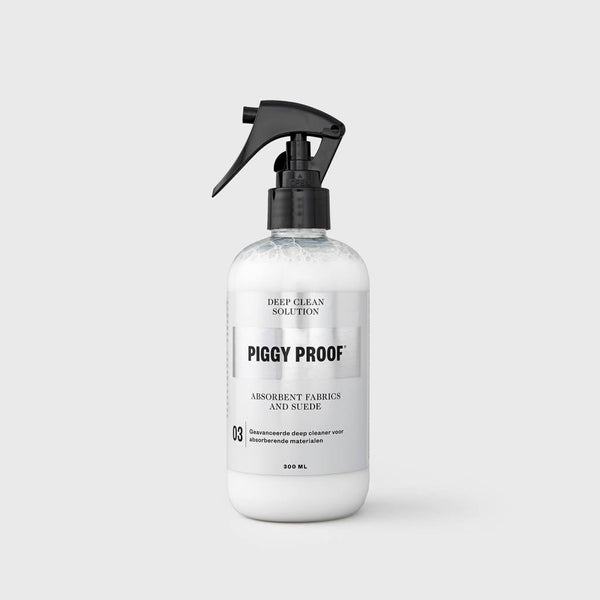
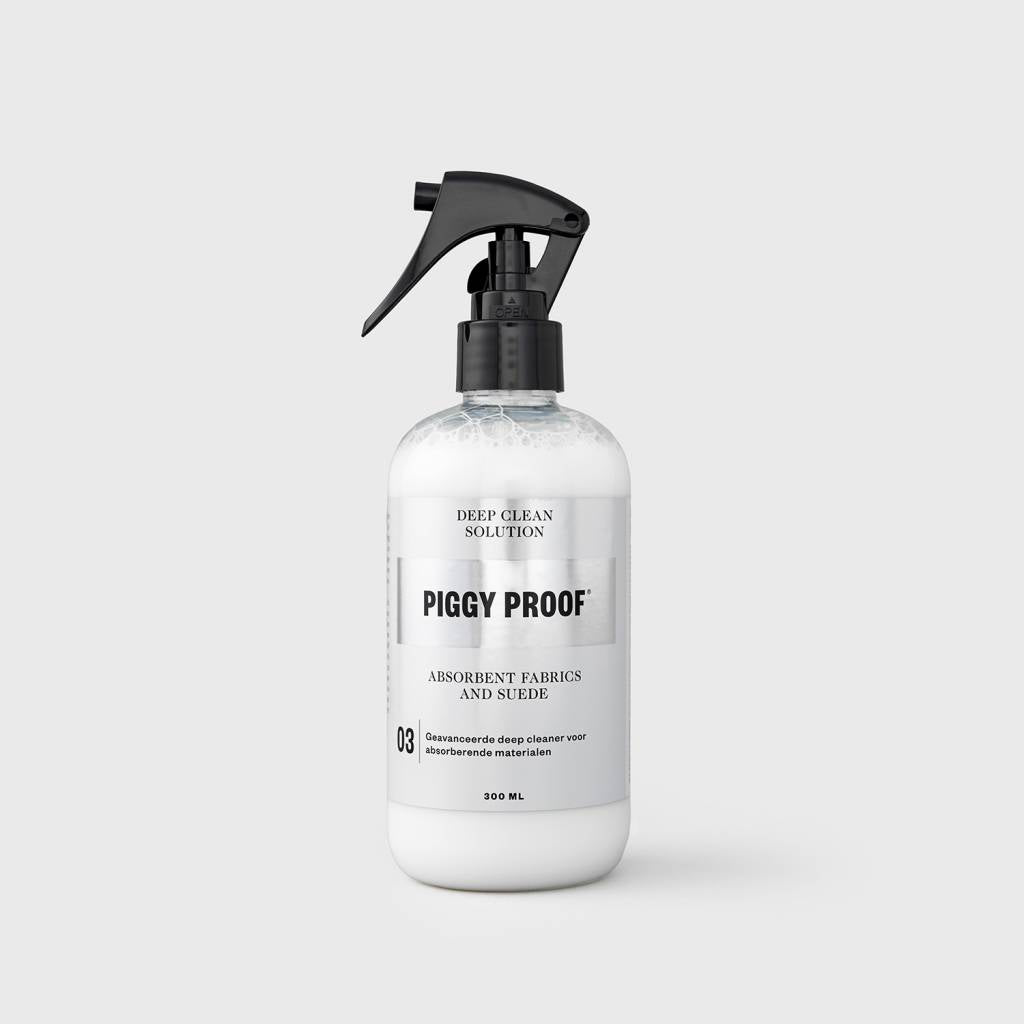
- Clean what remains with the Deep Clean Solution 03. This foam cleaner is made for suede and nubuck and works pore-deep, even when simpler methods fail.
It's rarely possible to completely remove an old, ingrained grease stain from suede. Expect improvement, not miracles, and treat the entire shoe afterwards so that the color difference is less noticeable.
Water stains and rings
Rain often leaves a rim: precisely where the water stopped running off. The trick is not to remove the stain, but to eliminate the color difference.
First, let the shoe dry completely. Then, lightly and evenly dampen the entire panel, from seam to seam, not just the ring. Stuff the shoe with paper to maintain its shape, let it dry for 24 hours at room temperature, and then brush up the nap again. In most cases, the rim will have disappeared.
Mud and street dirt
The biggest mistake with mud is cleaning it immediately. Let the mud dry rock hard, carefully break off the crust with your finger, and then brush away the rest. What remains in the fibers can be tackled with foam cleaner and a brush. Work panel by panel and not in small circles, to keep the color consistent.
Wine, coffee, and soft drinks
Liquid stains are a race against time. Blot the moisture immediately with a dry cloth, from the outside in so the stain doesn't spread. Let it dry and assess the damage. If discoloration remains, treat the entire panel with foam cleaner instead of just the small spot: a uniformly cleaned panel is much less noticeable than a spotlessly clean circle.
Salt rims in winter
Road salt leaves white, chalky rims, and these rims eat away at the fibers if you leave them. First, dry brush away the salt, then clean the rim with foam cleaner and let the shoe dry for 24 hours. Important: salt rims will return as long as the shoe remains unprotected. In winter, post-treating with a protector is not a luxury but a necessity.
Ink, makeup, and chewing gum
This is the category where you need to be realistic. Ink and makeup are full of pigment that binds to the fibers; chewing gum adheres mechanically.
For chewing gum, cooling works: place the shoe in the freezer in a bag for an hour, then carefully break off the hardened gum and brush away the rest. For ink and makeup, you can make one careful attempt with foam cleaner on a brush, always tested first on an inconspicuous spot. If that doesn't work, stop. Continuing to scrub will ruin the nap and the color.
Step-by-step: cleaning a stain with foam cleaner
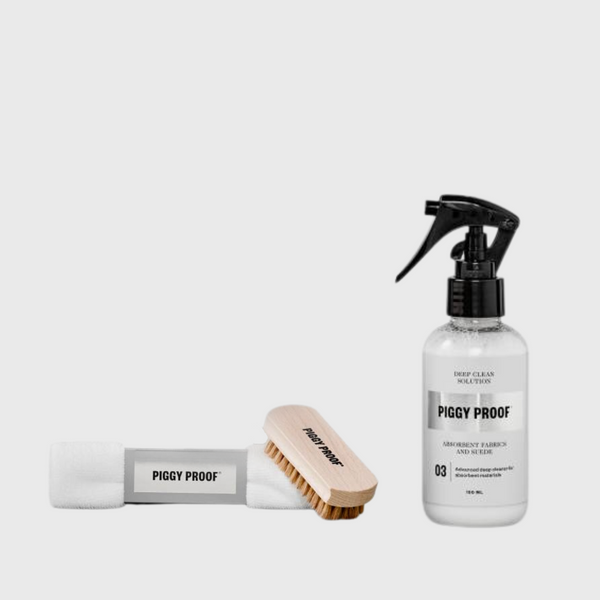
This is the method for almost all stain types mentioned above. You will need a cleaner, a brush, and a cloth; the Deep Clean Kit contains all three.
- First, remove loose dirt from the surface.
- Moisten the Brush To Clean & Protect with lukewarm water. The synthetic bristles do not absorb moisture or dirt themselves, so you won't transfer dirt back to the shoe.
- Spray the cleaner onto the brush or surface and brush until a rich foam forms. Work panel by panel, up to the seams.
- Blot dry with a clean microfiber cloth.
- Repeat if necessary and then let dry for 24 hours at room temperature, never over a heater.
- Brush up the nap once the shoe is bone dry. Suede often feels stiff after drying; this is normal and will disappear with brushing.
Always test first on an inconspicuous area and start with light colors if you're doing multiple pairs, so you don't transfer color.
Does this also work on a suede sofa or jacket?
Yes, the approach is the same, with one difference: for furniture and clothing, you can't just take one panel separately. Therefore, work from seam to seam, meaning an entire cushion or an entire sleeve at once, otherwise you'll see exactly where you stopped. For a sofa, always test first on the back or under a seat cushion. The cleaner and protector are suitable for suede shoes, clothing, and furniture, so you don't need a separate product for it.
When you should stop
Not every stain is a DIY job. Go to a shoemaker or suede specialist if:
- the stain has been there for months and has absorbed pigment (ink, paint, hair dye);
- it's a worn-smooth or flattened spot, because that's damaged nap and not dirt;
- the color has become clearly uneven over a large area after one cleaning;
- it's an expensive pair or a designer item that you don't want to experiment with.
Two careful attempts are fine. On the third attempt, you usually ruin the nap.
The most important step: protecting after cleaning
A cleaned suede shoe is at its most vulnerable at that moment: the fibers are open, and the old protective layer is gone. Therefore, always post-treat the shoe with the Premium Protector 01. This lays an invisible, breathable layer around each fiber that repels moisture, dirt, and oil, so that a subsequent stain has much less chance of penetrating. Odorless, water-based, and invisible, so you won't notice it.
Method: ensure the shoe is clean and dry, spray damply from 10 to 15 cm, gently rub in with the brush, repeat after 10 minutes, and let dry for 24 hours at room temperature. More about frequency and the water test can be found in the guide protecting suede. Consider it a small insurance policy for an expensive pair of shoes.
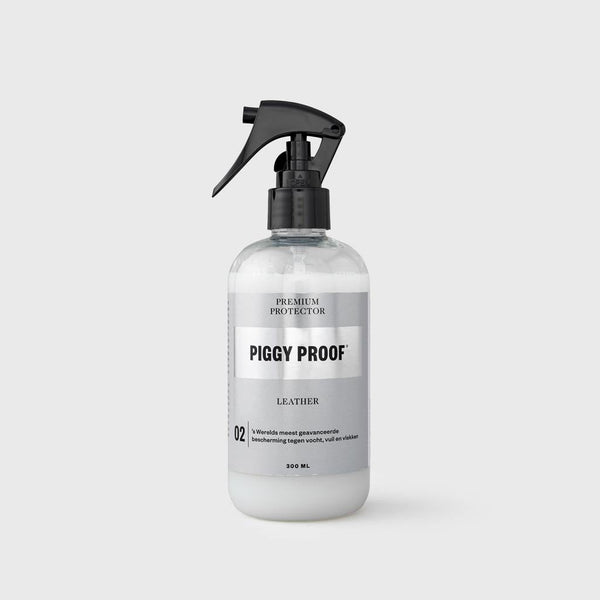
Note: Protector 01 is intended for suede, nubuck, and absorbent fabrics. If you have smooth leather or synthetic leather, use the leather variant.
Frequently asked questions about suede stains
Can you remove stains from suede with water?
With water alone, it rarely succeeds, and the risk of rings is high. Water soaks into the fibers and leaves a rim where it stops running off. If you do work with moisture, always dampen the entire panel evenly instead of just the stain, and then let it dry for 24 hours at room temperature.
How do I get a grease stain out of suede?
Blot fresh grease immediately with a dry cloth, then sprinkle absorbent powder such as cornstarch or talcum powder on it and let it sit overnight. Brush away the powder and treat what remains with a foam cleaner for suede, such as the Deep Clean Solution 03. Old, ingrained grease stains usually lighten but rarely become completely invisible.
Does a suede eraser help with stains?
An eraser primarily works against dry, superficial grime and shiny spots. For grease, wine, or ingrained dirt, an eraser doesn't go deep enough, and you risk flattening the nap. For these types of stains, you need a foam cleaner that works deep into the fibers.
Can suede shoes be washed in the washing machine?
No. The combination of a lot of water, heat, and drum movement makes suede hard, causes it to shrink, and damages the glue seams. Always clean suede by hand, with a brush and a cleaner made for the material.
How long should suede dry after cleaning?
Allow 24 hours at room temperature, with paper in the shoe to maintain its shape. Never place suede on a heater, in the sun, or with a hairdryer, as this will make the material hard and dull. Only brush up the nap once the shoe is bone dry.
Do I need to re-impregnate after removing a stain?
Yes. Cleaning removes not only the dirt but also the existing protective layer. After drying, treat the shoe again with a suede protector; this will make the material repel moisture, dirt, and oil again, giving you much more time to react to the next stain.